

On July 12, the Forever stamp went from 78 cents to 82 cents. Four cents doesn't sound like much until you multiply it by 150 invitations, 150 RSVP envelopes, and the one aunt who needs a second copy because the first one "never came."
Postage is the line item almost every couple forgets to budget for, and it tends to surface at the worst possible moment: standing at the post office counter with a box of finished invitations, learning your gorgeous square envelopes cost more to mail than you thought. Consider this your heads-up, plus everything else we wish couples knew before mailing day.
Sarah Houston Photography
The Numbers You Actually Need
Forever stamp (1 oz letter): 82¢
Each additional ounce: 29¢ (this one didn't change)
Nonmachinable surcharge: 49¢ per envelope, on top of everything else (more on this below)
Postcard stamp: 65¢, which makes postcards a great option for save-the-dates and RSVPs
International letter (1 oz): $1.75, for your guests overseas
Remember, all of this is per envelope.
What Actually Changes Your Postage
The post office doesn't care how pretty your invitation is. It cares about four things.
Shape. Square envelopes are classified as "nonmachinable" because they can't run through the automated sorters, which adds the 49¢ surcharge. Envelopes that are very tall and narrow, or close to square without quite being square, can land in the same category.
Weight. One stamp covers one ounce. Every layer adds up: heavy cardstock, an inner envelope, vellum wraps, belly bands, a details card, a map. Cross the one-ounce line and every invitation needs an extra 29¢.
Lumps and stiffness. Wax seals, clasps, buttons, ribbon, twine, and very rigid suites can all trigger the nonmachinable surcharge, because they don't bend the way the machines need them to. This one surprises people: it applies even when the wax seal is on the invitation inside the envelope. If it makes the envelope lumpy, it counts.
Thickness. A letter can be up to a quarter inch thick. Go past that (a boxed invitation, a padded suite, a chunky wax seal stacked on layered paper) and it stops being priced as a letter and starts being priced as a large envelope, which costs noticeably more.
Weigh One Before You Buy a Single Stamp
The single most important tip in this post: assemble one complete invitation with every card, wrap, and seal in place, and take it to the post office counter to be weighed and measured. Leave the envelope unsealed. If it comes in just over an ounce, you can swap the paper, move a details card to your wedding website, or trim a layer right there instead of paying extra on every envelope.
They'll tell you the exact postage, including any surcharge. Do this before you order custom stamps, not after. Ask us how we know.
Hand Canceling, Explained
The Reeses
Every stamp has to be "canceled" before it's delivered, which is the postmark that marks it as used so it can't be peeled off and reused. Normally a machine does this, and that same machine can scuff, bend, and smudge envelopes, leave a printed barcode across the bottom, and crush wax seals.
Hand canceling means a postal clerk stamps the postmark on each envelope by hand at the counter instead. Your envelopes skip that first machine, which is the one most likely to do damage. If your suite includes a wax seal, inside or out, hand cancel every single one.
How to ask for it:
Call ahead. Not every post office offers it, and policies vary. Smaller branches are usually your best bet.
Go at a slow time. Mid-morning on a weekday beats the lunch rush. Nobody wants to hand-stamp 150 envelopes with a line out the door.
Bring them ready to go. Stamped, sealed, and addressed, with nothing left to do but cancel.
Ask kindly. Mention they're wedding invitations. Some offices do it free, some charge a few cents per envelope, and some will hand you the stamp and let you do it yourself.
Never drop them in a mailbox. Wedding invitations go over the counter, into a person's hands.
Have a backup branch in mind in case your first stop says no.
One honest caveat: hand canceling protects your invitations at the first stop, but they may still pass through sorting equipment further down the line, and every so often an envelope simply gets lost. It's the best protection you have, not a guarantee, which is why the next section matters.
Mailing Day Tips
Order extras. Envelopes get lost, damaged, or misaddressed, and there's always a last-minute guest. Plan for at least 5 to 10 percent more invitations than your count, and a few more envelopes than that for addressing mistakes.
Mail one to yourself first. It's the cheapest quality check you'll ever do. See how it arrives, how long it takes, and what the envelope looks like on the other side.
Keep addresses readable. Calligraphy is beautiful, but the scanner still has to read it. Dark ink on light envelopes is easiest. Light or metallic ink on a dark envelope needs strong contrast, so confirm with your calligrapher.
Stamp in the upper right corner, and put the return address on the back flap.
Don't Forget the RSVP Envelope
If you're including a reply envelope, it needs its own stamp and your address already on it. Your guests should not have to pay to tell you they're coming. That's another 82¢ per invitation, and it's the cost couples miss most often.
Two ways to trim it: swap the reply envelope for an RSVP postcard at 65¢, or skip mailed RSVPs and send guests to your wedding website. (If you go digital, keep a handful of printed reply cards for the grandparents. They will call you otherwise.)
Let's Do the Math
Say you're sending 120 invitations.
A simple 1-ounce suite with an RSVP postcard: 82¢ plus 65¢, so $1.47 per guest, or $176.40 total.
A square, wax-sealed 2-ounce suite with a stamped reply envelope: $1.11 plus the 49¢ surcharge, plus 82¢ for the reply, so $2.42 per guest, or $290.40 total.
A layered 2-ounce suite with a stamped reply envelope: $1.11 for the invitation plus 82¢ for the reply, so $1.93 per guest, or $231.60 total.
Same guest list, more than $100 between the first and last option. None of these choices is wrong. You just want to make them on purpose, before the counter makes them for you.

The Reeses
Custom Postage: The Prettiest Detail Nobody Expects
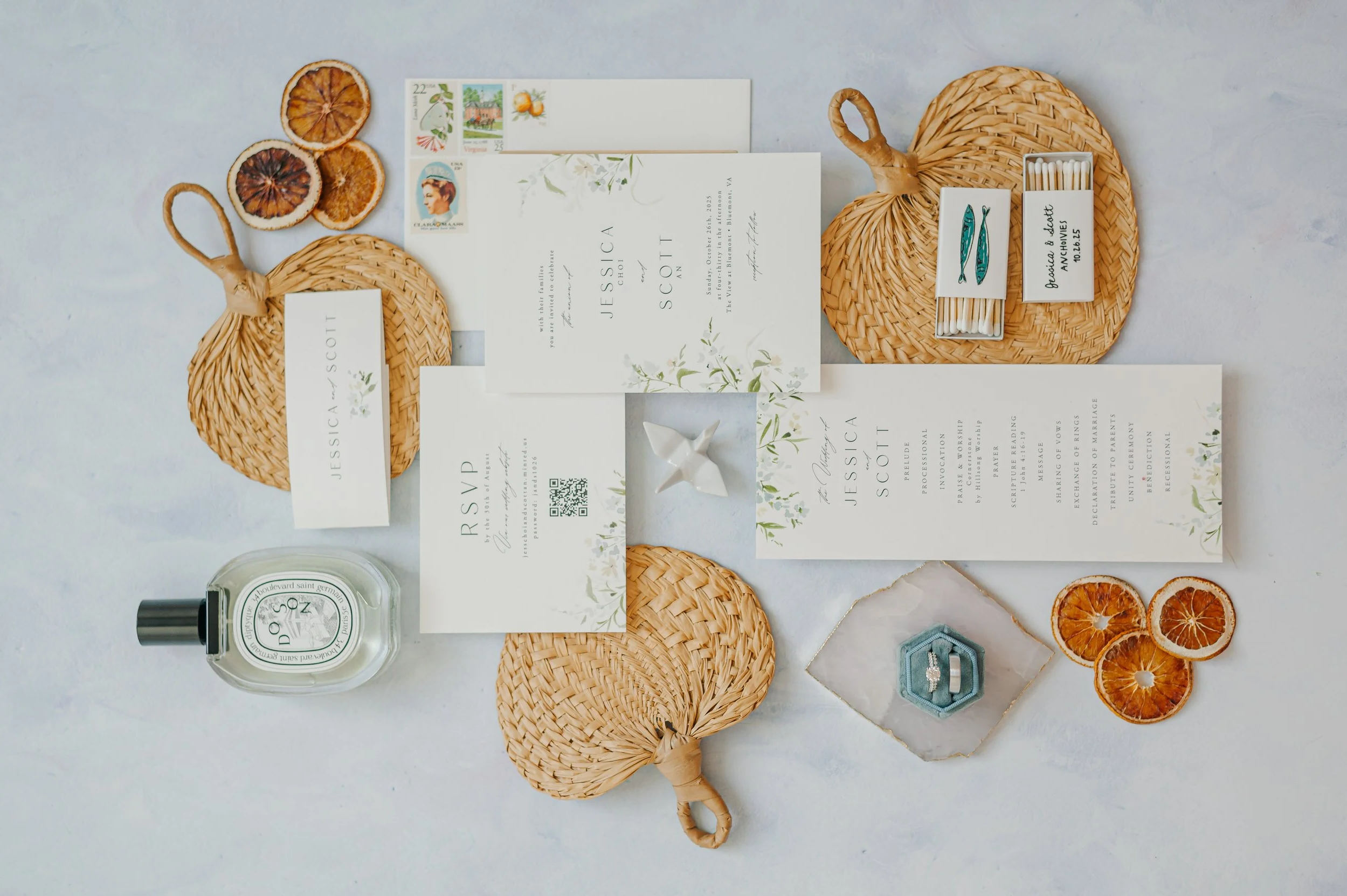
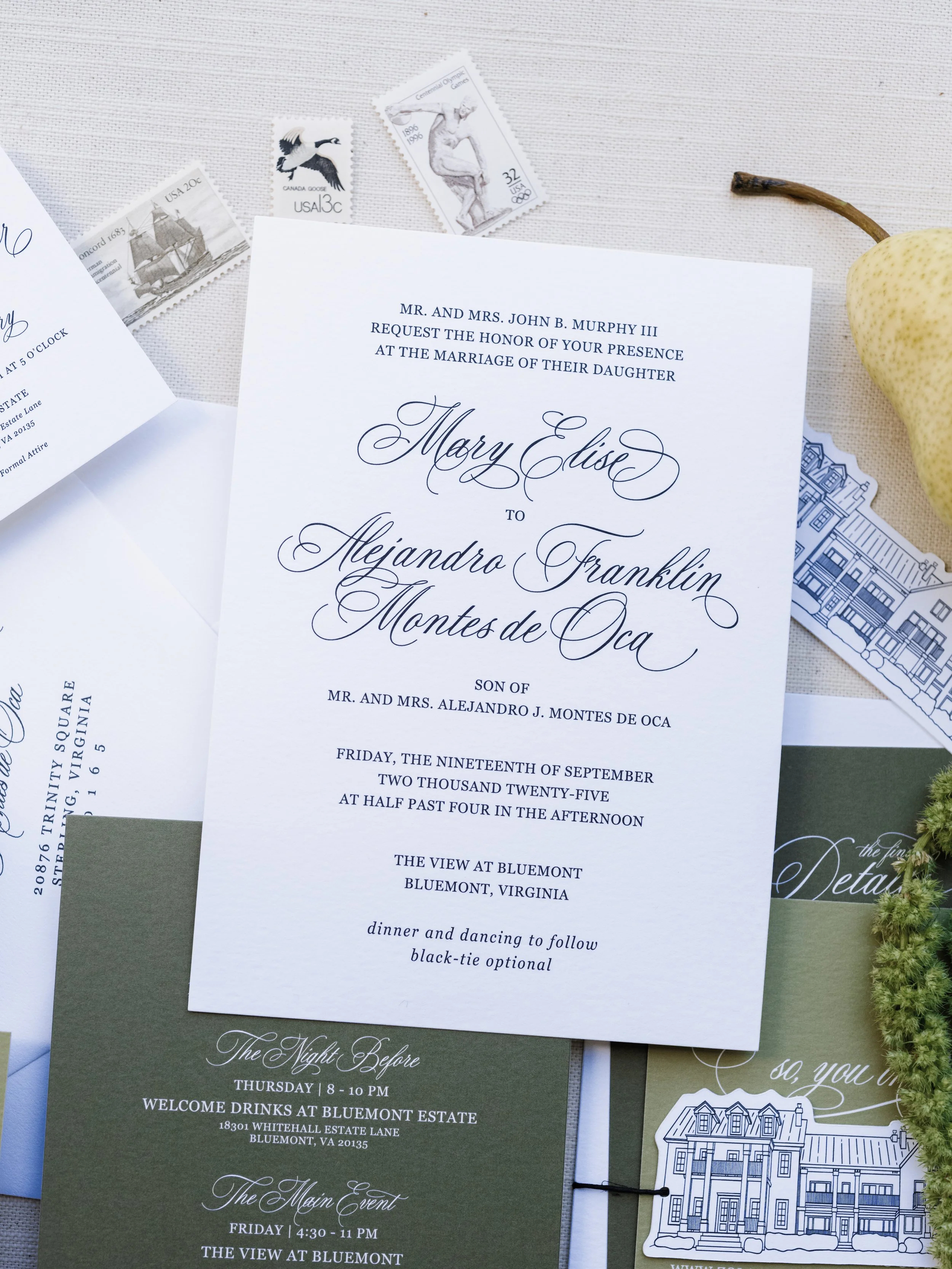
This is my favorite part. U.S. stamps never expire, which means unused vintage stamps from decades ago are still valid postage at their printed value. A 15¢ stamp with a little bird on it, a 20¢ floral, and a few small denominations can add up to exactly what your invitation needs, and give the envelope an heirloom look your guests will notice before they even open it. Bonus: if you're paying the nonmachinable surcharge anyway, a curated set of stamps makes that extra postage look intentional.
The catch is that finding the right stamps, in enough quantity, in your colors, at the right values, is a whole project. That's where postage curators come in. Artists like @flourishfinewriting pull together custom vintage stamp combinations designed around your invitation suite, so the envelope feels like part of the design instead of an afterthought.
If you're working with a postage curator:
Weigh your suite first so they know exactly how much postage each combination needs to add up to, surcharge included.
Share your palette and stationery so the stamps actually match.
Order early. Curated sets take time to source, so build it into your invitation timeline well before mailing day.
Leave room on the envelope. Three or four stamps take up more space than one, so give your stationer and calligrapher a heads-up.
Worth knowing: curated vintage postage costs more than the face value of the stamps, because you're paying for the sourcing and design. Think of it as a design choice rather than a way to save on postage.
When to Buy Your Stamps
Forever stamps are worth whatever a first-class stamp costs on the day you mail them, so stamps bought last spring at 78¢ still cover a letter today. USPS has been raising rates regularly, so once you know your final postage, there's no harm in buying early.
Most invitations go out six to eight weeks before the wedding, and closer to three months out for a destination wedding or a guest list with a lot of travelers. Plan your hand-canceling trip around that date, not the week of.
How We Handle This for Our Couples
For our full-service couples, postage lives in the invitation timeline from the very beginning, right next to the stationery order. We weigh the final suite, confirm the rate, line up custom postage if you want it, and build the cost into the budget so there are no surprises at the counter. It's one small piece of making sure the details of your day are handled before you even think to worry about them.
Xo, Taylor
Taylored Society Events is a luxury wedding and event planning company serving Virginia, Washington, DC, Maryland, West Virginia, Pennsylvania, New Jersey, and where ever you are - specializing in full service planning and wedding coordination designed around emotion, guest experience, and days that run beautifully.
-
A standard invitation weighing one ounce or less needs one Forever stamp, currently 82¢. Each additional ounce adds 29¢, and square, lumpy, or rigid envelopes add a 49¢ nonmachinable surcharge. The safest move is to have one fully assembled invitation weighed at the post office.
-
Square envelopes, very tall or narrow envelopes, and suites with wax seals, clasps, buttons, ribbon, or twine, or that are thick, rigid, or lumpy. That includes a wax seal on the invitation inside the envelope.
-
Hand canceling means a postal clerk postmarks your envelopes by hand instead of running them through the canceling machine, which helps protect wax seals, calligraphy, and delicate envelopes from smudges, barcodes, and tears.
-
It depends on the post office. Some offer it free, some charge a few cents per envelope, and some don't offer it at all. Call ahead and visit during a slow time of day.
-
Yes. Reply envelopes and RSVP postcards should be stamped and addressed to you before they go in the invitation, so your guests can drop them right in the mail.
-
Yes. U.S. postage stamps don't expire, so unused vintage stamps are valid at their printed value. Combine several to reach the total postage your invitation needs, or work with a postage curator who builds the combinations for you.
-
Six to eight weeks before the wedding is standard. For destination weddings or guest lists with a lot of travelers, send them closer to three months ahead.